
How BAP approached steel pipe manufacturing MES development for a Japanese-owned factory in Vietnam, where 65 of 75 surveyed business processes relied on Excel or Google Sheets.
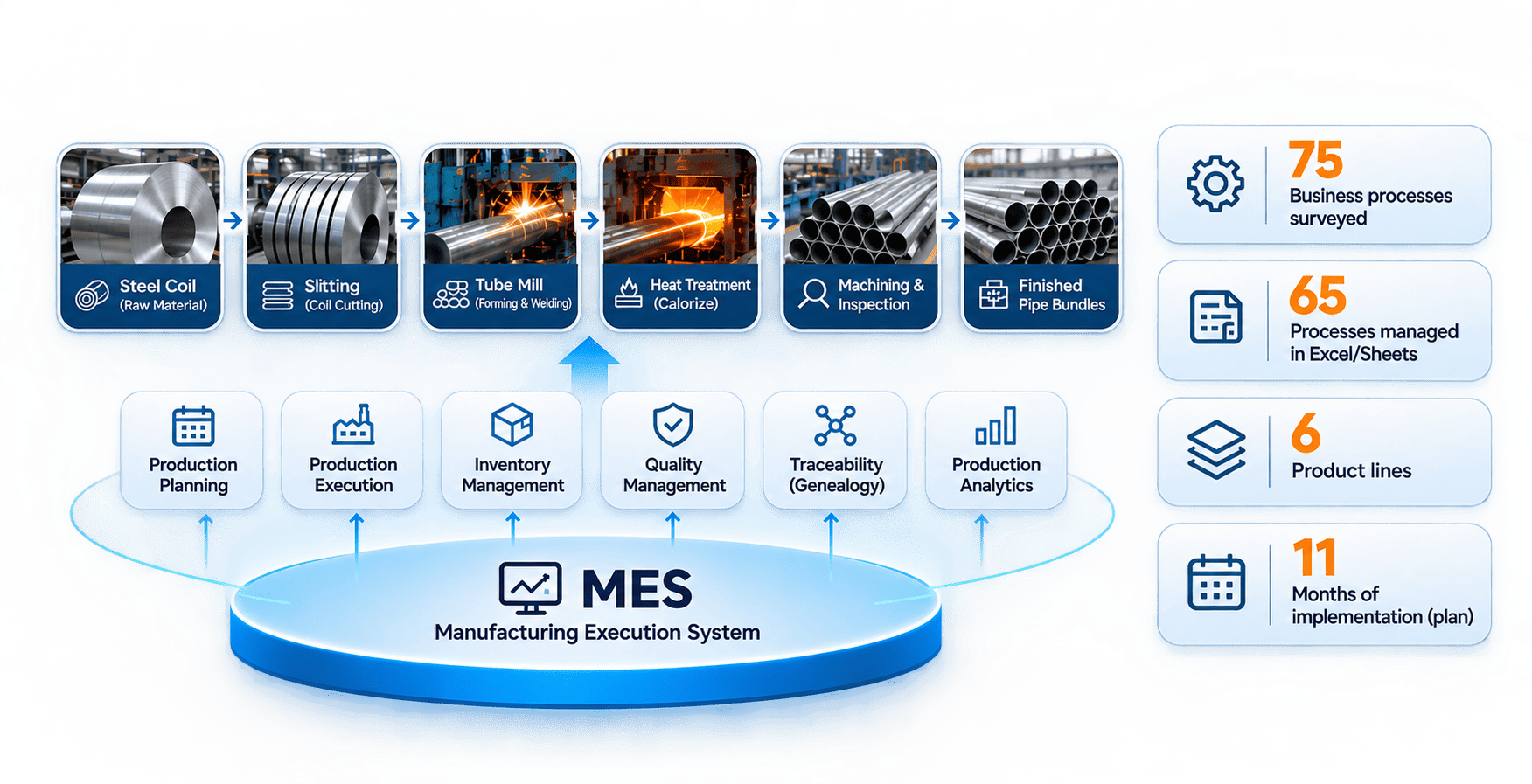
A steel pipe manufacturing facility processes hundreds of tonnes of raw materials every month. Across production lines, teams need to coordinate material movements, monitor production output, inspect product quality, and maintain accurate inventory records.
But what happens when much of that information is managed in separate spreadsheets? For one Japanese-owned steel pipe manufacturer in Vietnam, this was a significant operational challenge. The factory processed approximately 687 tonnes of steel coils per month across production processes supporting six product lines. While its manufacturing operations involved multiple interconnected stages, much of the information used to manage those operations remained fragmented. Production figures were compiled from shop-floor reports. Inventory records were maintained across different departments. Quality inspection results and equipment operating conditions were stored separately. As a result, obtaining a complete picture of factory operations required considerable manual effort. During the initial assessment, BAP reviewed 75 business processes and found that 65 relied on Excel or Google Sheets. The challenge was not simply to replace spreadsheets with software. It was to establish a connected manufacturing data foundation that could support production visibility, inventory control, quality management, and end-to-end traceability. This case study explores how BAP approached the design and development of a Manufacturing Execution System (MES) tailored to the complexities of steel pipe production.
01. Project Overview: Digitalizing a Japanese-Owned Steel Pipe Factory
The client operates a welded steel pipe manufacturing facility in Vietnam. Its production process begins with steel coils and continues through slitting, tube forming, heat treatment, surface treatment, machining, and quality inspection. The factory manufactures six product lines, each involving different processing requirements and production conditions. One of the key challenges was managing materials as they moved between manufacturing stages. At the beginning of production, raw materials are primarily measured by weight. As processing continues, products are tracked by individual pieces or bundles. Heat treatment introduces another layer of complexity: multiple production lots may be processed together in a single furnace batch. Without a consistent data structure, maintaining accurate records across these transitions becomes difficult.
Project at a Glance
| Category | Project Details |
|---|---|
| Industry | Metal Processing & Welded Steel Pipe Manufacturing |
| Client | Japanese-owned steel pipe manufacturing facility in Vietnam |
| Project Scope | Factory-wide operations across six product lines |
| BAP Services | Business process analysis, MES design, and system development |
| Key Functional Areas | Production planning, production execution, inventory management, quality management, traceability, and data analytics |
| System Integration | ERP, PLCs, furnace controllers, weighing equipment, and related devices |
02. The Challenge: When Spreadsheets Become a Barrier to Manufacturing Visibility
Spreadsheets are widely used in manufacturing because they are familiar, flexible, and easy to implement. For individual tasks, they can be highly effective. However, as production operations grow more complex, managing information across dozens of disconnected files creates limitations. BAP’s assessment identified four major challenges.
Limited Visibility into Production Performance
At the Tube Mill stage, yield and scrap rates were calculated by consolidating multiple production records at the end of each month. While this provided an overall performance summary, it made it difficult to identify variations during production. For example, if material loss increased during a particular shift or while processing a specific steel coil, managers needed more detailed information to investigate the cause. Monthly reports alone could not provide the timely visibility required for that analysis.
Fragmented Inventory Records
Inventory was tracked across four levels, covering incoming tubes, work-in-progress, semi-finished products, and finished goods. The assessment also identified approximately 63,671 semi-finished pieces subject to manual inventory counting. With inventory information maintained across separate records, reconciling quantities between manufacturing stages required additional effort. This made it harder to obtain a consistent view of where materials and products were located throughout the factory.
Disconnected Quality and Production Data
Product quality depends on numerous factors, including raw material properties, welding conditions, furnace temperatures, machining parameters, and inspection results. At the factory, these records were maintained in different files. When a quality issue occurred, teams had to gather information from multiple sources to reconstruct the product’s manufacturing history. This fragmented approach increased the effort required for root-cause investigations.
Manual Collection of Equipment Data
Some operating information from the Tube Mill and temperature readings from 18 heating zones across two furnaces were manually recorded by operators. This created repetitive data-entry work and limited the ability to use equipment information for timely production analysis. BAP therefore focused on building a connected manufacturing data platform rather than simply digitizing individual forms.
03. BAP’s Approach: MES Designed for Complex Manufacturing Processes
Steel pipe manufacturing cannot always be represented by a single production model. Different stages of the process operate in fundamentally different ways. Continuous manufacturing: Materials move through processes such as slitting and tube forming, with production quantities commonly measured by weight. Batch manufacturing: Multiple production lots may be combined in a single heat-treatment batch. Discrete manufacturing: Products are tracked as individual pieces, bundles, or lots during machining and finishing. A successful MES must maintain accurate relationships between these production models. 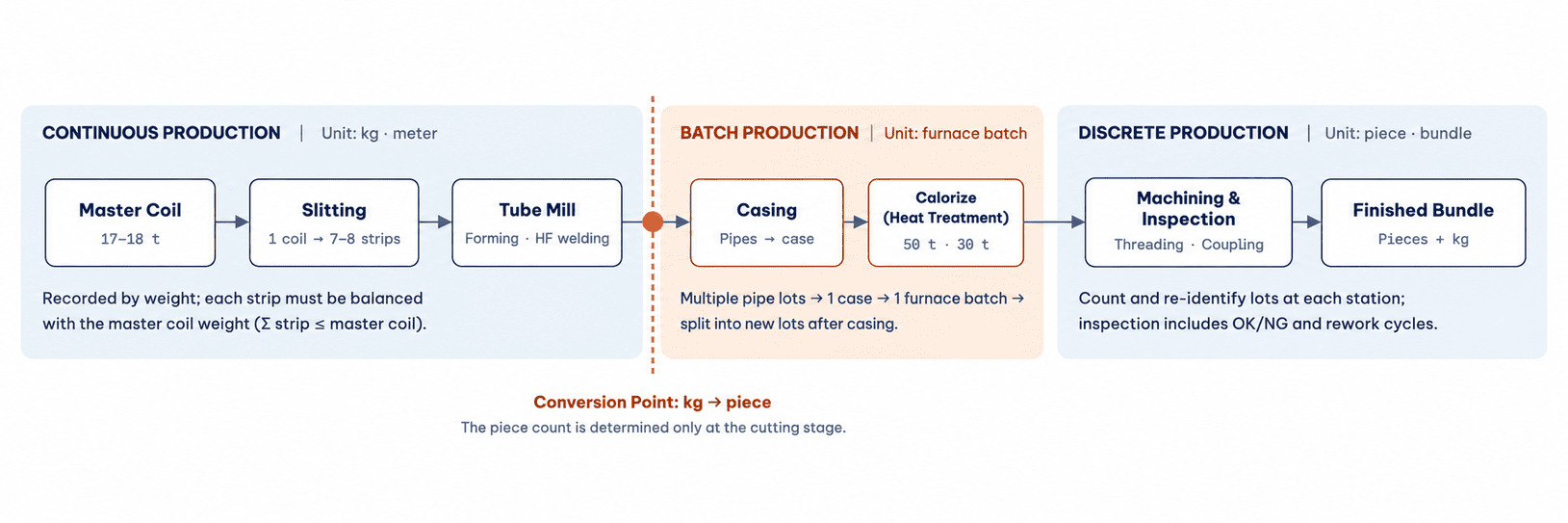
BAP addressed this requirement through four core design principles.
Connecting Weight-Based and Piece-Based Tracking
The MES data model was designed to manage both material weight and product quantities. This included recording the conversion between kilograms and individual pieces as steel moved through cutting and processing stages. The objective was to enable consistent reconciliation between raw material consumption, production output, and scrap.
Preserving Lot Relationships Across Production Stages
In steel manufacturing, one material lot may be divided into several production lots. Conversely, multiple lots may be combined during heat treatment. BAP designed a Lot Genealogy structure to preserve these relationships. This provides the foundation for tracing finished products back through intermediate processing stages to their original raw materials.
Linking Production Conditions with Quality Results
The system design also connects manufacturing recipes, material consumption, processing conditions, and quality measurements to the relevant production lots. This enables production and quality information to be analyzed together rather than treated as separate datasets.
Standardizing Inventory Data
Inventory movements across manufacturing stages were organized around a common data model. The goal was to improve consistency in recording material movements, inventory quantities, and work-in-progress status throughout the factory.
04. Core MES Capabilities: One Connected Manufacturing Platform
Based on the factory assessment, BAP organized the MES into six primary functional areas.
| MES Function | Key Capabilities |
|---|---|
| Production Planning | Manufacturing orders, process scheduling, job tickets |
| Production Execution | Process-level output, material yield tracking, downtime reasons |
| Inventory Management | Raw materials, work-in-progress (WIP), semi-finished products, and finished goods |
| Quality Management | Inspection records, non-conformance reports (NCR), 4M change tracking, and equipment calibration |
| Traceability | Lot genealogy, bundle identification (Bundle ID), and QR code tracking |
| Analytics & Reporting | Material yield, scrap rate, Overall Equipment Effectiveness (OEE), and equipment operating data |
The MES was designed to serve as the primary platform for collecting and managing shop-floor production information.
The existing ERP system would continue to handle business functions such as order management and accounting. This approach allows the manufacturer to build on its existing technology investments while introducing the capabilities needed for more detailed manufacturing control. The architecture also follows an API-oriented approach, with planned integration points for shop-floor tablets, PLCs, electronic weighing devices, furnace controllers, and label printers.
05. Tube Mill Optimization: Understanding Material Yield at Coil and Shift Level
Material yield is a critical performance indicator in steel pipe manufacturing. Differences between input material weight and finished output can be influenced by material characteristics, product dimensions, equipment settings, and processing conditions. At the Tube Mill stage, the factory’s monthly reference figures included:
- 96.7% material yield
- 3.3% scrap rate
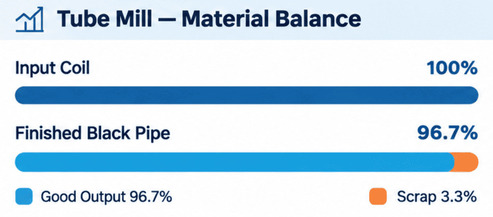
※These figures represent reference production data, not improvements achieved after MES implementation.
Previously, yield calculations were primarily consolidated at the end of each month.
BAP designed a QR-based identification process to link slit coil information with production records. The objective was to support yield calculations at both coil and shift levels, enabling more detailed analysis than monthly summaries alone. With this data structure, production teams would be better equipped to investigate material loss by steel grade, product size, raw material supplier, or operating conditions. The value extends beyond measuring how much material was consumed. It lies in understanding where losses occur and providing reliable data to support improvement decisions.
06. End-to-End Traceability: From Finished Bundles Back to Raw Steel Coils
Consider a situation in which a customer reports a quality issue with a delivered batch of steel pipes. To investigate, the manufacturer needs to answer several questions. Which raw material coil was used? Which manufacturing stages did the products pass through? Were they processed in a particular furnace batch? What were the operating conditions and inspection results? When this information is stored across multiple spreadsheets, reconstructing the complete manufacturing history can take considerable time. To address this challenge, BAP designed a backward traceability structure based on the finished product’s Bundle ID. The traceability chain connects: 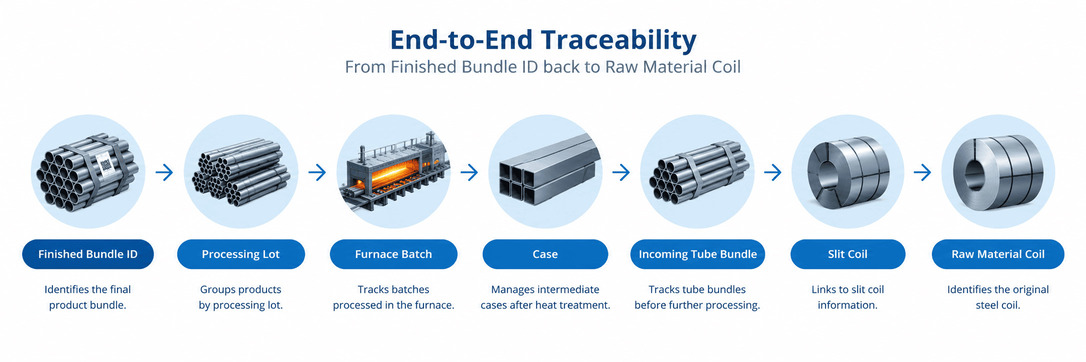
The underlying data model preserves relationships when lots are split, combined, or transferred between production stages.
It also links relevant quality information, including furnace temperatures, welding parameters, dimensional inspection results, material certificates, and 4M change records. The intended outcome is a centralized source of manufacturing history that supports faster investigations and more consistent quality management.
07. Implementation Roadmap: A Phased Approach Over 11 Months
Introducing MES into an operating factory requires more than deploying new software. The system must reflect actual production workflows, fit the needs of shop-floor operators, and maintain reliable information during the transition. 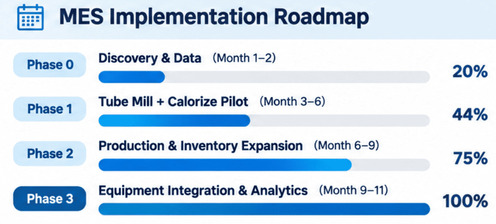
For this reason, BAP adopted a phased implementation approach within an 11-month project plan.
The roadmap began with business process assessment and data model design, followed by three implementation phases covering core capabilities, functional expansion, integration, testing, and deployment preparation. Throughout the project, particular attention was given to production data consistency, inventory accuracy, traceability relationships, and equipment connectivity. The implementation approach also included prototype reviews with factory personnel and parallel operation alongside existing spreadsheet-based processes. These activities were intended to identify practical issues early and reduce operational risks during system transition. Rather than introducing every function simultaneously, the phased approach allows the solution to be validated and expanded progressively.
08. Measuring MES Success: Four Target KPIs
The success of a manufacturing system should not be measured solely by the number of features delivered. Its value depends on whether it reduces manual work, improves data reliability, and helps teams respond more effectively to production issues. For this project, four key performance targets were defined.
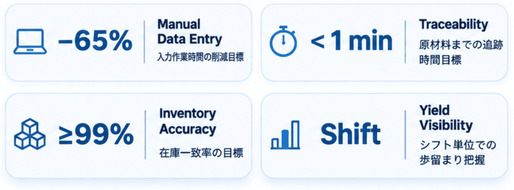
※Important: These figures are project design targets and acceptance criteria. They should not be interpreted as verified post-implementation results.
Additional planned capabilities included automated daily and monthly reporting, furnace temperature data collection, QR-coded product labels, and reduced reliance on manual recordkeeping.
Together, these capabilities are intended to establish a more reliable foundation for manufacturing visibility and continuous improvement.
09. What Makes an MES Project Successful?
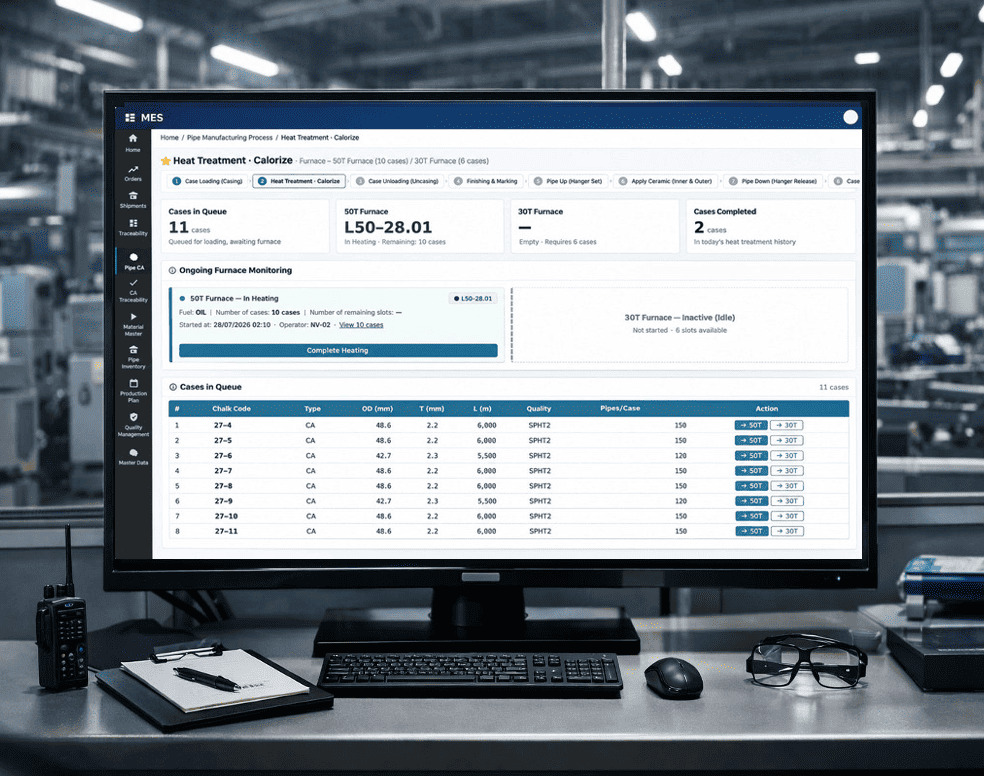 This project highlights an important lesson: implementing MES is not simply a software development exercise. A technically sophisticated system will deliver limited value if it does not reflect how the factory actually operates. BAP’s approach emphasizes four principles.
Start with the Data, Not the Screens
Existing spreadsheets often reveal how work is actually performed. By examining production records, forms, and information flows before designing interfaces, teams can identify which data needs to be retained, standardized, or connected.
Design Around Manufacturing Reality
Steel pipe production combines weight-based materials, piece-based quantities, batch processing, and complex lot relationships. The MES architecture must accurately represent these relationships to preserve data integrity across production stages.
Validate with Shop-Floor Users
Operators and production supervisors understand the practical constraints of daily manufacturing operations. Involving them in prototype reviews helps ensure that workflows and interfaces are suitable for real factory conditions.
Implement in Phases and Validate with KPIs
A phased rollout creates opportunities to verify data accuracy, evaluate operational readiness, and address issues before expanding the system across additional processes. Together, these principles support an MES that is not only technically sound but also practical for long-term factory operations.
10. From Disconnected Spreadsheets to Connected Manufacturing Data
The steel pipe factory already generated substantial amounts of operational data. Information about raw materials, production output, inventory, quality, and equipment existed throughout the organization. The challenge was that these records were fragmented, making them difficult to consolidate, verify, and use effectively. BAP approached the project by examining the factory’s workflows, identifying relationships between manufacturing stages, and designing an MES platform to connect information from raw materials through finished products. The broader lesson is relevant to many manufacturers pursuing digital transformation. The first step is not necessarily collecting more data or introducing more technology. It is understanding how existing information flows through the factory and building a reliable foundation that allows it to be used effectively.
Planning an MES or Smart Factory Initiative?
BAP supports manufacturing companies with MES, Warehouse Management Systems (WMS), Quality Management Systems (QMS), production management solutions, ERP integration, and industrial IoT connectivity. Our Japanese-speaking project managers and bridge system engineers work alongside development teams to support projects from business analysis and solution design through development, deployment, and ongoing operations. Whether your factory relies heavily on spreadsheets, struggles with fragmented inventory records, or needs stronger production traceability, we can help you explore an approach suited to your operations. Connect your manufacturing data. Build a stronger foundation for continuous improvement. Explore BAP’s Manufacturing DX & MES Solutions: https://mes.bap-software.net/